It is my pleasure to introduce a guest post from Nina Čuk, a researcher at the University of Ljubljana whose work sits at the fascinating—and often overlooked—intersection of microbiology and material science.
We spend nearly every moment of our lives in contact with textiles, yet we rarely consider them as living ecosystems. In the piece below, Nina pulls back the curtain on the “social lives” of bacteria and explains why our favorite fabrics are so appealing to these microscopic travelers. From the complex architecture of biofilms to the high-stakes science of laundering multi-drug-resistant bacteria, Nina breaks down why the “how” and “why” of textile hygiene matters more today than ever.
Please join me in welcoming Nina Čuk as she shares the vital research her team is conducting to keep our homes and healthcare environments safer.
Nina Čuk
The Story Behind the Bacteria
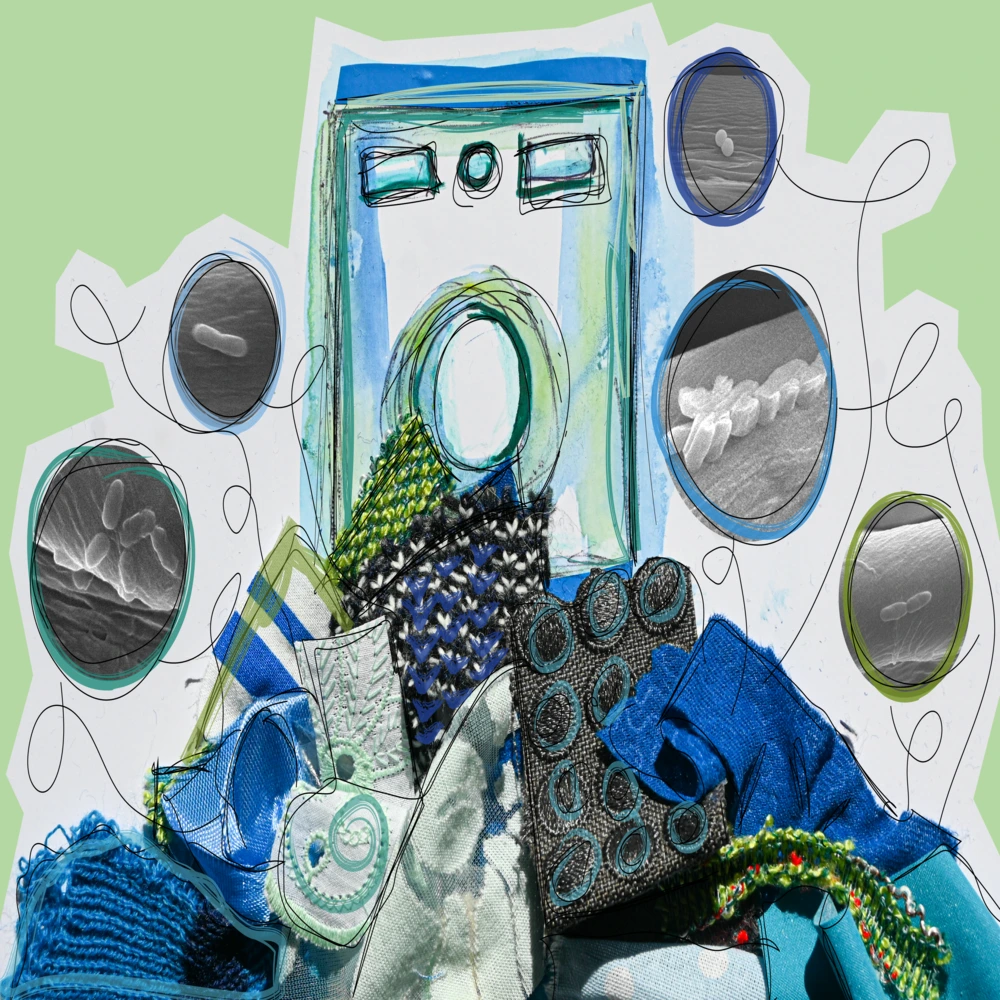
Bacteria lead a life that we cannot normally see with the naked eye – and yet it is full of mystery, some of which are revealed with the microscope. Society does not have all the information about bacteria, even though they live all around us and can be found both inside and outside the human body. Normally they mind their own business, ensuring the functioning of their vital functions and their rapid division. In some ways, they are »faster« than humans due to their simplified cell, which does not have organelles like human cells. They also have to adapt and react quickly to rapid changes and stresses in the external environment. From this point of view, they can be very creative and advanced, as they have developed many mechanisms to fight against such unpleasant conditions. Their creativity has also become noticeable for humans, as bacteria have become increasingly resistant to the effects of common antibiotics. In a sense, bacteria are also »social creatures«, as they usually prefer to live in communities called biofilms rather than in the planktonic form. Such biofilms can consist of one and the same bacterial strain but can also be very diverse and contain microorganisms of very different strains. In such communities, they join and survive unfavorable living conditions more easily. This can be less pleasant for humans, and the claim that it is easier to prevent the formation of biofilms than to remove them once they have formed still applies here. However, the biofilm is not a final and unchangeable form, because bacteria are also travelers, always looking for better conditions and places. One of the most suitable places for them to live is textiles.
Brief Theory of Textiles
Textiles are indeed a fusion of human creativity and intelligence, as they contain both artistic and technological elements in their production. Although they have long gone hand in hand with humans, their basic principles are still very much the same as they were many decades ago. Textiles made with a lot of traditional backgrounds are favorable for bacteria due to the large surface area and the ability to absorb moisture. However, not all textiles have the same ability to absorb water, which is a consequence of their chemical composition and structural properties. There are therefore many different raw materials from which woven, knitted and non-woven fabrics are made. When the customer receives their own clothes, it is important to care for them properly to get rid of unwanted dirt and bacteria. If the user lowers the washing temperature, this means that the other components of the washing process (chemicals, mechanical action or time) must be increased. It is therefore quite a challenge to find the optimal washing conditions to ensure hygiene on the one hand and to fulfil environmental friendliness on the other.
When Bacteria Meet Textiles
When bacteria meet textiles, the relatively simple explanation of the individual actors becomes quite complex. The presence of bacteria or bacterial adhesion and biofilm formation on textiles involves three variables: Bacteria, textiles and environment. It should also be considered that bacteria are living organisms, while textiles have unique properties under different external conditions. To properly understand the complexity, the studies required for this should be multidisciplinary, examining the situation from several different perspectives. This is the recognized research gap that our team has focused on.
The Work of Our Team
As previously mentioned, the presence of bacteria on textiles is a current topic that we are addressing in our studies. In this context, we have also written a scientific review article on the influence of textile factors on bacterial adhesion [1]. The article includes an introduction, which presents the process of biofilm development and summarizes the current state of the literature. The next section covers theoretical approaches, providing explanations and relevant formulas that describe bacterial adhesion from different perspectives. The following paragraph divides textile factors into chemical and physicochemical properties on one side, and constructional and textural properties on the other. Each textile factor (namely chemical composition, surface charge, hydrophilicity/hydrophobicity, surface free energy, roughness, and porosity) is explained and described; moreover, their synergistic effects are also considered. The conclusions of this article can serve to develop new strategies and proposed guidelines for the design of antiadhesive textile surfaces. Besides being simplified and systematic, it also provides visual support for the complex topic presented.
The interdisciplinary study, provided by the team, deals with the behavior of multi-drug-resistant bacteria (methicillin-resistant Staphylococcus aureus, Klebsiella pneumoniae and Acinetobacter baumannii) on household textiles [2]. The household textiles consisted of different raw materials, namely 100 % cotton, 100 % polyester and a blend of 35/65 % polyester/cotton, and therefore had different properties (e.g. surface roughness and surface free energies). However, they pose a significant risk for the transmission of the aforementioned multi-drug-resistant bacteria, especially through polyester. The same study also found that sufficient hygiene can be ensured if such textiles are washed at 60 °C with a reference detergent, whereas washing at 30 °C is not sufficient. However, the addition of disinfectants to the detergent at 30°C met all hygiene requirements with the complete elimination of the tested bacteria on all household textiles used.
For Those Who Want More
More of our articles are available online. You are welcome to search there for further information. [1] ČUK, Nina, SIMONČIČ, Barbara, FINK, Rok, TOMŠIČ, Brigita. Bacterial adhesion to natural and synthetic fibre-forming polymers: influence of material properties. Polymers. 2024, vol. 16, iss. 17, [article no.] 2409, str. 1-30, ilustr. Available on: https://www.mdpi.com/2073-4360/16/17/2409
[2] ČUK, Nina, LUNDER, Manca, TOMŠIČ, Brigita, FINK, Rok (avtor, korespondenčni avtor). Multidrug-resistant bacteria on household textiles : characteristics, transmission and low temperature washing. Biofouling. 2025, vol. 41, no. 5, str. 470-484. Available on: https://www.tandfonline.com/doi/full/10.1080/08927014.2025.2497295#abstract
[3] ČUK, Nina, SIMONČIČ, Barbara, KOSTAJNŠEK, Klara, BIZJAK, Matejka, FINK, Rok, TOMŠIČ, Brigita. The reasearch journey: investigating the role of textile properties in bacterial adhesion. V: GORJANC, Marija (ur.), et al. Crossing boundaries : 50th International Symposium on Novelties in Textiles : 10th Conference on Information and Graphic Arts Technology : proceedings : 29–30 May 2025, Ljubljana, Slovenia. Ljubljana: Faculty of Natural Sciences and Engineering, 2025. Str. 100-104. Available on: https://www.ntf.uni-lj.si/igt/wp content/uploads/sites/8/2025/05/CIGT2025_proceedings.pdf
[4] TOMŠIČ, Brigita, OFENTAVŠEK, Lara, FINK, Rok. Toward sustainable household laundry. Washing quality vs. environmental impacts. International journal of environmental health research. 2024, vol. 34, no. 2, str. 1011-1022. Available on: https://www.tandfonline.com/doi/full/10.1080/09603123.2023.2194615
[5] FORTE-TAVČER, Petra, BRENČIČ, Katja, FINK, Rok, TOMŠIČ, Brigita. Influence of hydrogen peroxide on disinfection and soil removal during low-temperature household laundry. Molecules. 2022, vol. 27, iss. 1, str. 1-11. Available on: https://www.mdpi.com/1420-3049/27/1/195