The challenge of providing basic human necessities on a global scale remains immense: an estimated 2.1 billion people still lack access to safe drinking water. In many parts of the world, “safe” is a guessing game because testing is too expensive, too slow, or requires a laboratory that simply doesn’t exist nearby.
Filling this critical gap is Aquagenx, a company that has simplified field-based water quality testing. Their tests do not require laboratories, electricity, complicated equipment or highly trained analysts. These features enable NGOs, non-profits, humanitarian aid, government, and researchers to conduct water quality testing in low resource, rural, remote and disaster areas. Aquagenx tests are used in approximately 125 countries.Helping to drive the company’s mission since 2012 is Lisa Hirsh, who brought her start-up, early-stage company background to Aquagenx. She was drawn to Aquagenx by the powerful combination of the company’s humanitarian aspect and the elegant science made simple in their core testing product.
The “Why” Behind the Design: Elegant Science Made Simple and Portable
In 2013 Aquagenx introduced its original product, the Compartment Bag Test for E. coli. The test was developed in the early 2000s by Dr. Mark D. Sobsey, an international authority in environmental health microbiology and virology and in water, sanitation and hygiene (WASH).
Dr. Sobsey was driven to develop the Compartment Bag Test to help solve the global water quality crisis that kills millions of people every year due to water contaminated by fecal bacteria. His goal was to invent a simple, affordable test so water quality testing can be done in the field outside of labs in low and middle income countries.
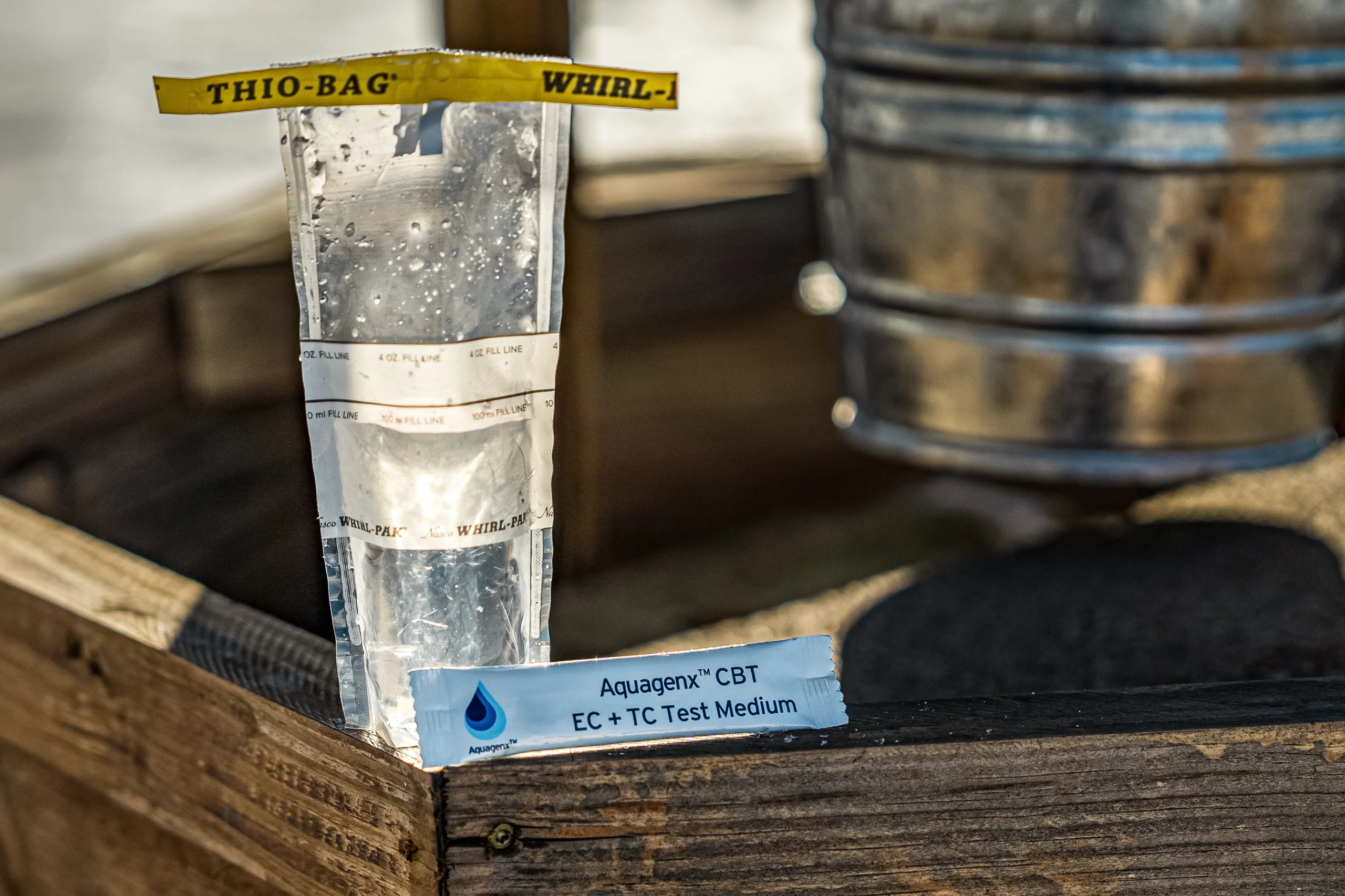
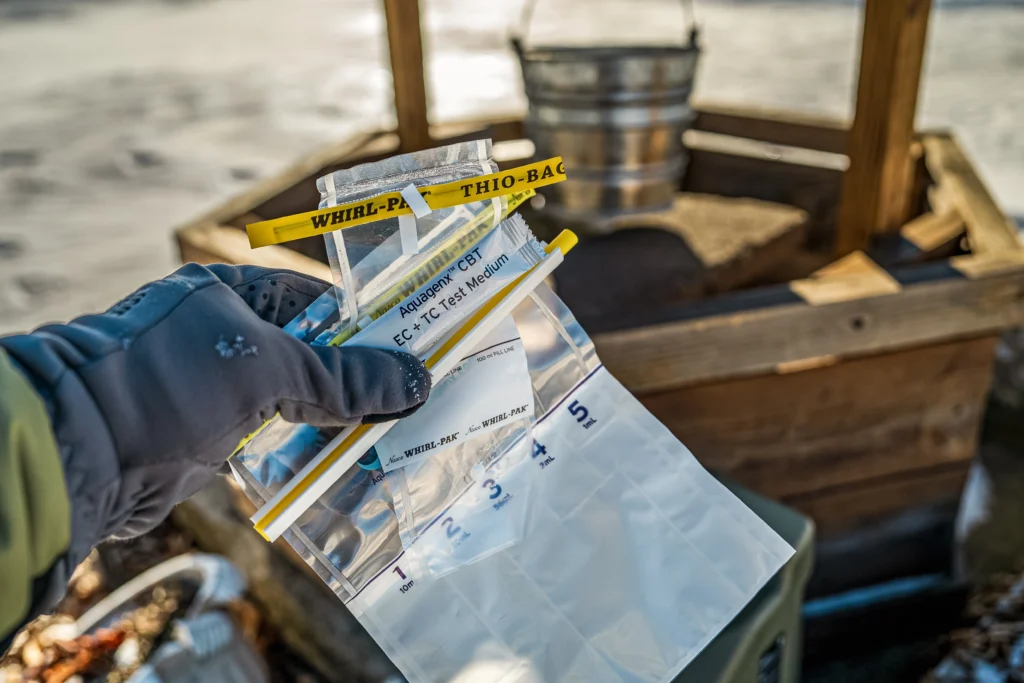
The Compartment Bag Test (CBT) is based on the Most Probable Number” (MPN) principle similar to that of the EPA approved multiple tube fermentation method. Instead of a lab-based test using glass test tubes, Aquagenx incorporated separate “test tubes” into a plastic bag that can be easily used in the field.
” The basis for the five compartments was to have sufficient compartments to get reasonably good estimates of the concentrations of bacteria,” Lisa explains. “Fewer compartments would provide less precise estimates.More than five compartments would add complexity and be more difficult for users in the field.”
Engineered for Today, Scaled for Tomorrow
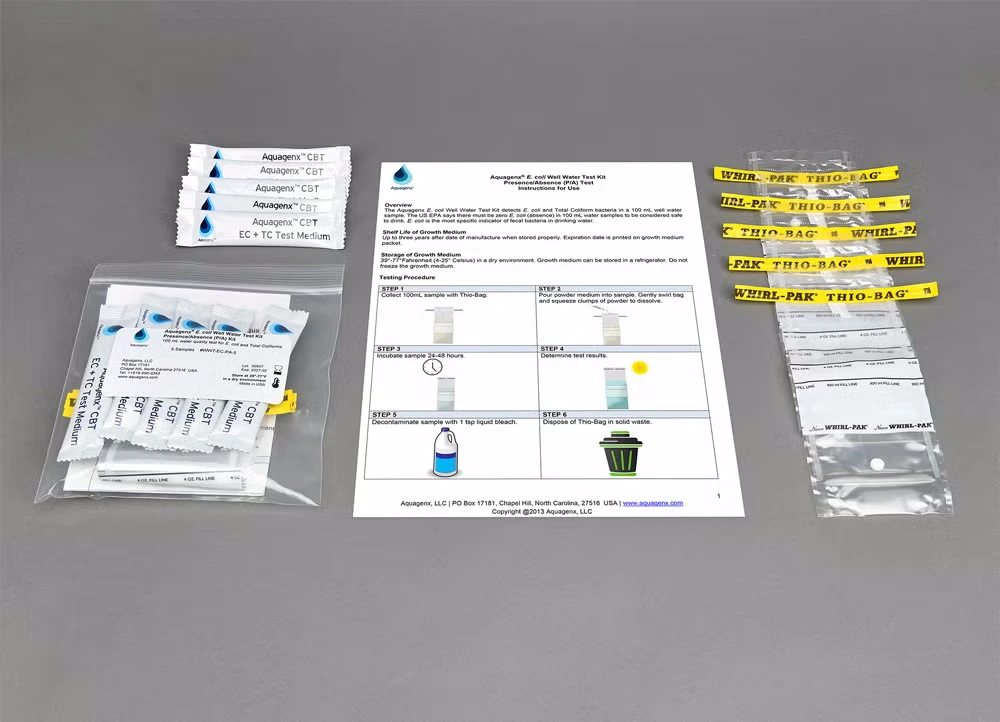
The Aquagenx product line has continuously evolved. They’ve moved from the original E. coli-only test to a two-in-one test for both E. coli and Total Coliforms, the CBT EC+TC Kits. These come in both Presence/Absence and Most Probable Number versions.
In a significant step forward, Aquagenx released the GEL EC CFU Kit, which allows users to count actual bacteria colonies (CFUs) without needing membrane filtration equipment. In 2024 Aquagenx introduced their Antimicrobial resistant ESBL E. coli Kits, as antimicrobial resistance poses a major threat to human health around the world and impacts the human, food chain and environment sectors.
They also offer Field Kit Collections—essentially a water lab in a backpack—combining their microbial tests with third-party chemical and physical tests and equipment
Insert paragraph from my email that begins with “Ongoing, routine water quality testing is crucial…”
To help ensure success with their water quality test kits, Aquagenx prioritizes customer support. Customers can receive online Zoom demonstrations, and the company maintains a content-rich website with foundational resources for their products and water quality testing in general. Aquagenx also provides responsive Technical Support for their products.
Breaking Down Barriers: Why Governments and NGOs are Making the Switch
For international governments and NGOs, the fundamental hurdle isn’t just how to test water, but how to keep testing it year after year. Complex methods require specialized training and “cold chain” logistics that often fall apart in rural or disaster zones.
Aquagenx tests are designed to break these barriers. Their water quality test kits requires no laboratories, no electricity, and no highly trained analysts.
“Routine water quality testing might be abandoned if it’s difficult and unsustainable,” Lisa warns. “Complex testing methods that require extensive capacity, resources, time, and training risk sacrificing institutional and community engagement.”
By making the process “field-ready,” Aquagenx ensures that monitoring doesn’t stop when a project funding cycle ends. It empowers a transition toward “self-sustaining business models, local control, and locally accepted technologies,” which Lisa believes is the right direction for the world to ensure safe water for everyone.
Strategic Partnerships: Addressing America’s Overlooked Water Crisis
While Aquagenx was forged in the global humanitarian space, they are now turning their focus toward the United States. Many Americans,especially private well owners and disenfranchised rural communities,face similar barriers to safe water. Sending samples to a lab can be expensive and slow, creating a persistent gap in water safety knowledge.
This is why the partnership with Business Connect is so vital. By leveraging Business Connect’s scale and online marketplace, Aquagenx can get a reliable water quality test kit into the hands of US citizens quickly.
“Business Connect has the scale, reach, and online marketplace that can help us bring our products to our fellow citizens more quickly, in a way we cannot on our own,” Lisa notes.
What’s Next for Aquagenx?
Aquagenx is developing new microbial tests and a family of high-efficiency, portable field incubators to make on-site testing even more reliable in cooler climates.
The goal for the next year is clear: “An ever-increasing uptick of our tests and greater awareness of our products around the world,” while successfully expanding into new markets like the USA.
A Clear Path to Safe Water
“Many customers tell us they never previously conducted water quality testing, and our simple field tests kits make this both possible and successful for their organizations,” says Lisa.